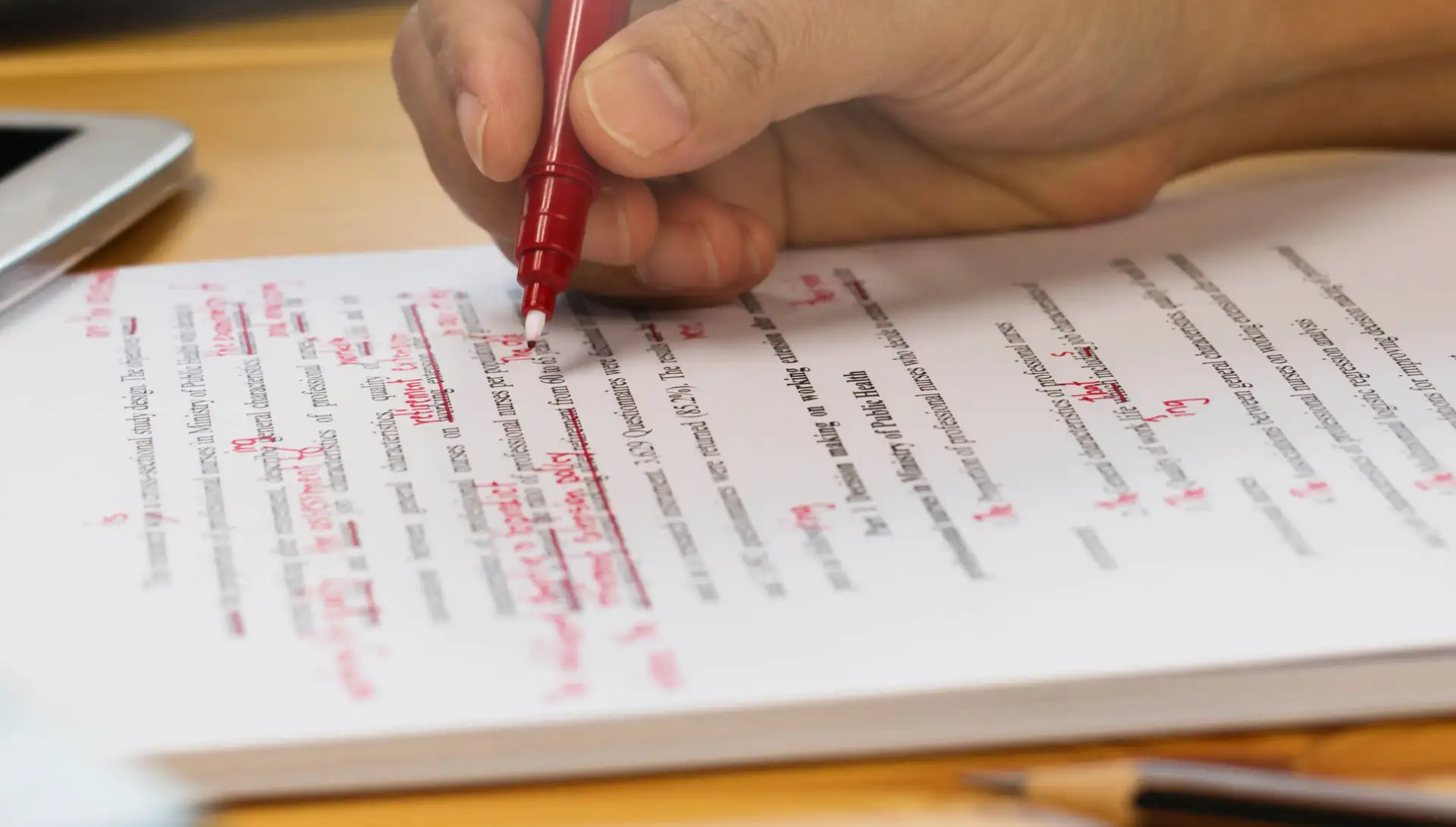
Editor SHARNÉ DENNER has caught it all: misplaced modifiers, wayward commas and adjectives run amok. Here, she rounds up eight recurring writing crimes and delivers the correct rules.
Editors have been called ‘the traffic cops of the arts’ (Gene Fowler), and although I don’t fancy myself an expert on writing in any shape or form, I have nonetheless amassed an interesting collection of oddities and recurrent writing errors from the novels and other works I have had the joy of editing. There’s a fine line between respecting an author’s voice and intent and disregarding the foundational rules of grammar and punctuation. Literary anarchy ensues!
I hope to offer readers a short list of problem areas and errors I commonly come across, along with some titbits that may be useful to keep in mind during your writing adventure (or may at least provide some much-needed moments of humour).
Subjunctive mood (the mood most writers kill without realising it)
The subjunctive mood is a verb form used to express doubt, demands, wishes, suggestions or hypothetical situations. It is commonly found in formal, legal and academic writing, but can also lend nuance to literary and fiction writing when used correctly. Here are a few examples:
- ‘If time were to stand still, I would be able to finish this essay in time.’ (‘Were’ instead of ‘was’ indicates a hypothetical situation.)
- ‘I insist that I/he/she/we/you be allowed to attend the court proceedings.’ (‘Be’ instead of ‘am’, ‘is’ or ‘are’ is used after ‘insist’ to express a demand.)
- ‘I demand that everyone have an opportunity to speak.’ (‘Have’ instead of ‘has’.)
- ‘They suggested that she visit the museum.’ (Singular ‘visit’ instead of the expected ‘visits’.)
From this, you may have surmised the rules:
In English, the subjunctive is often indicated by the use of the base form of the verb, regardless of the subject: ‘be’ is used instead of ‘am’, ‘is’ or ‘are’; ‘have’ instead of ‘has’; and singular verbs lose their ‘-s’ or ‘-es’ endings. In hypothetical or contrary-to-fact situations, ‘were’ is used instead of ‘was’.
This is also the rule behind that eternal dinner-table debate: is it ‘if I was you’ or ‘if I were you’? Grammatically, ‘were’ wins every time in a hypothetical because you are not, in fact, me, so the subjunctive applies. ‘Was’ has crept into casual speech so widely that it barely raises an eyebrow anymore, but in careful writing, ‘were’ is still the mark of someone who knows what they’re doing.
That/who as relative pronouns (pick a lane)
Now we’re getting into the technical bits. According to the Oxford English Dictionary, a pronoun is ‘a word used instead of a noun to indicate someone or something already mentioned or known’ (OED, 2011). There are, in fact, seven different types of pronouns – as a nerdy party trick, they are personal, possessive, demonstrative, interrogative, indefinite, relative and reflexive – but we are going to focus on the commonly misused category of relative pronouns and, specifically, when to use ‘that’ and ‘who’.
As a useful general rule, use ‘who’ when referring to people and ‘that’ when referring to things, places or animals. ‘Who’ can also be used for named animals or pets, particularly when they are regarded as individuals rather than simply as animals.
- ‘The gardener who shapes the rose bushes is hired seasonally.’
- ‘The rose bushes that are budding need to be fertilised.’
- ‘This is the beach that I have heard so much about.’
- ‘Meet Fido, the dog who loves to chase our postman.’
- ‘The mice that were in the lab were in dedicated cages.’
One grey area worth a mention: groups of people. ‘The team that won the final’ and ‘the team who won the final’ are both defensible. ‘That’ treats the team as a single unit, ‘who’ nods to the individuals within it. Neither is wrong, but pick one and be consistent within a piece rather than switching back and forth.
Oxford/serial comma (the tiny mark that starts family feuds)
A serial (or Oxford) comma is a comma placed immediately before the final conjunction (‘and’ or ‘or’) in a list of three or more items. Although often treated as optional, it may be necessary in certain situations to avoid confusion or humorous misunderstandings. Some style guides, including the Chicago Manual of Style, the APA Publication Manual and the MLA Handbook, mandate its use, whereas others, such as the Oxford Style Manual, recommend it, particularly where it helps to avoid ambiguity.
If you’re writing for an academic journal, it’s advisable to follow the journal’s local or house style, which will specify whether the serial comma should be used. Regardless of which style is chosen, be sure to apply it consistently throughout your writing.
Here are some humorous examples of situations in which omitting the serial comma can cause some commotion:
- ‘This book is dedicated to my children, Elvis Presley and my cat.’ (What a lineage.)
- ‘Our story includes tales of the president, an avid bird watcher and a serial stalker.’
- ‘I invited the strippers, JFK and Stalin.’
Correct use of semicolons vs commas vs colons (punctuation’s most abused love triangle)
An often over- and misused punctuation mark is the comma, and knowing how to create variation in your writing by using semicolons and colons is an essential skill. However, it won’t do to simply replace all commas with semicolons or, worse still, colons. Trying to summarise the various uses of the comma in an article would be folly, so let’s focus on where and how to correctly use semicolons and colons.
A semicolon is primarily used in two ways. First, to separate two or more closely related independent clauses that are closely connected in meaning and could stand as independent sentences in their own right. Second, to separate items in a list when those items already contain commas. In this case, semicolons help clarify the structure or hierarchy of a complex list.
Here is a sentence where a semicolon is used incorrectly:
- ‘I love cake; especially red velvet.’
The semicolon is incorrect because ‘especially red velvet’ is not an independent clause. A comma would be more appropriate here: ‘I love cake, especially red velvet.’
However, were the sentence ‘I love cake, my husband prefers cupcakes’, the comma would also be incorrect. These are two independent clauses that are closely connected, so the comma creates what is known as a comma splice. The comma could be replaced with a semicolon: ‘I love cake; my husband prefers cupcakes’ (or a dash, if you’re feeling spicy).
Now, check out these two lists:
- ‘I like cows: they give us milk, which is a source of calcium; they give us beef, which is a source of food; and they give us leather, which can be used for clothing and shoes.’
- ‘The judge called on Sarah, the forensic analyst; Joe, the detective; Anna, the emergency responder; and Mark, the deceased’s husband.’
Can you see why leaving semicolons out of either of these lists would create some understandable confusion? In the first example, the semicolons separate the three reasons why the speaker likes cows, each of which already contains a comma. In the second, they distinguish each person from their job description, making the structure of the list much easier to follow.
Colons, on the other hand, are a bit more flexible. They point forward: from an introduction to a conclusion, from a cause to an effect, from a general statement to an example. They can also be used to introduce lists or direct speech. Unlike the material following a semicolon, the material following a colon does not necessarily need to be an independent clause.
Lynne Truss describes this function quite well: ‘A colon is nearly always preceded by a complete sentence, and in its simplest usage it rather theatrically announces what is to come. Like a well-trained magician’s assistant, it pauses slightly to give you time to get a bit worried, and then efficiently whisks away the cloth and reveals the trick complete’ (Truss, 2003). Enough said.
Kill adjectives (gently, and only some of them)
Adjectives are an essential part of any story. They add depth, nuance and intrigue; however, overuse can make your writing laborious and stuffy (cue: yawn!), and risk irritating the reader. Mark Twain rather infamously said ‘When you catch an adjective, kill it.’ But I think that may be a bit of an overkill. As all things in life, balance is key.
Consider, for example, the following excerpt from The Picture of Dorian Gray by Oscar Wilde:
‘The studio was filled with the rich odour of roses, and when the light summer wind stirred amidst the trees of the garden, there came through the open door the heavy scent of lilac, or the more delicate perfume of the pink-flowering thorn.’
Now, let’s strip all those lovely adjectives away:
- ‘The studio smelled of roses. A breeze came through the open door, carrying the scent of lilac and thorn.’
Ouch. It seems we have butchered poor Wilde’s writing. He would turn in his grave. Okay, now let’s add a few overly used, less precise adjectives:
- ‘The studio was filled with the nice, beautiful smell of roses, and when the gentle, pleasant summer breeze came through the open door, it carried the lovely, sweet, breathtaking smell of lilac and the pretty smell of the pink, thorny flowers.’
Never mind the fact that we have used the word ‘smell’ three times; I feel as though I need an antihistamine after all that scent description – and perhaps a cup of coffee to wake me up. Boring!
Adjectives, used correctly, can be powerful writing tools. The aim is not to eliminate them completely, but to select your arsenal carefully and apply them purposefully. With practice (and a good thesaurus!), this is one skill worth honing.
Powerful verbs (retire ‘walked’ and ‘looked’ already)
Nothing quite loses a reader like a storyline in which the characters’ actions feel flat. If there’s a lot of walking, talking, saying, sleeping and looking happening, the reader may soon be snoring and closing the book.
Although there is beauty in simplicity, verbs that are used with intent and precision can transform a narrative. There’s a general principle of ‘show, don’t tell’ in fiction writing, which encourages writers to describe actions, emotions and experiences in a way that allows readers to picture and experience them rather than simply being told about them. Choosing precise, evocative verbs is one way to achieve this.
Instead of saying, ‘She walked to the bar with attitude and daintily sat down on the edge of a stool, looking stealthily at the gentleman to her left’, action verbs can render the same scene much more vividly: ‘She sauntered over to the bar and glided onto a stool, eyeing the gentleman to her left.’ It’s shorter, less reliant on adverbs and paints a clearer, more powerful picture.
Dialogue and action tags (beyond ‘he said, she said’)
In addition to the powerful action verbs discussed above, there are myriad ways to add drama and variety to your story through dialogue tags and action beats. Instead of relying on the usual he said, she said, he shouted and she asked, consider the emotion and intent of the scene and choose your dialogue tags accordingly. Action beats can also be used alongside dialogue to convey emotion and context without explicitly telling the reader how a character feels.
A quick illustration of the difference: ‘I’m fine,’ she snapped, tells the reader how she feels through the tag itself. ‘I’m fine,’ she said, folding the receipt into smaller and smaller squares, tells the reader the same thing through action instead. The latter usually lands harder, because the reader works out the emotions themselves.
Something to keep in mind is that too many colourful dialogue tags can become distracting for the reader. Although overused, ‘he said’ and ‘she said’ are almost invisible to the reader, which is often exactly what you want.
Misplaced/dangling modifiers (only read this carefully)
A modifier is a word, phrase or clause that adds information to another word or clause to elaborate, describe or specify it. A common writing sin is found with the word ‘only’, which is tacked on wherever seems comfortable. Not so. Modifiers, such as ‘only’, ‘almost’ and ‘just’ should ideally be placed as close as possible to the word or phrase they modify.
Consider the fairly funny possibilities when ‘only’ is misplaced in these sentences:
- Only I told Sally that I love her. (Nobody else told Sally they love her.)
- I only told Sally that I love her. (As opposed to singing it to her, I suppose.)
- I told only Sally that I love her. (Ah, it seems Sally is the sole recipient of his declaration of love.)
- I told Sally only that I love her. (Sally was told that he loves her, and nothing else.)
- I told Sally that only I love her. (Sally is loved by only one person, poor girl.)
- I told Sally that I only love her. (He loves her, but he doesn’t necessarily like her.)
- I told Sally that I love only her. (A profession of love to a single girl, no one else.)
- I told Sally that I love her only. (A profession of love to a single girl, no one else.)
The same principle applies to longer phrases and clauses, where a modifier can end up appearing to modify the wrong word or even the wrong subject. This is known as a dangling modifier. Consider the sentence: ‘Putting on my pyjamas, a mouse ran across the floor.’ The opening phrase appears to describe the mouse, making it sound as though the mouse is putting on pyjamas. Unless we’re discussing Stuart Little here, the sentence needs to be recast. For example: ‘While I was putting on my pyjamas, a mouse ran across the floor.’
This has been but a short foray into the dynamite-packed, ever-changing world of English grammar and punctuation. Although many a literary friendship seems to have ended over online wars on the use of the serial comma, not to mention the use of ‘who’ and ‘whom’ and ‘due to’ or ‘owing to’, I would remind you that even the most salt-and-peppered seasoned editors look up at least one grammar rule every day. We are, all of us, learners of an art.
Here is a short list of resources I consider invaluable:
- SA Writers’ College: The Advanced English Grammar Course
- SA Writers’ College: Grammar Skills (English 2nd Language)
- SA Writers’ College: The Mastering Punctuation Course
- Chartered Institute of Editing and Proofreading: Getting to Grips with Grammar and Punctuation
- Editandtrain: Training courses: English Grammar for Editors
- Ben Yagoda: When You Catch an Adjective, Kill It
- Noah Lukeman: A Dash of Style: The Art and Mastery of Punctuation
- William Strunk Jr.: The Elements of Style
References:
- Stevenson, A., & Waite, M. (Eds.). (2011). Pronoun. In Concise Oxford English Dictionary (12th ed., p. 1149). Oxford University Press.
- Truss, L. (2003). Eats, Shoots & Leaves: The Zero Tolerance Approach to Punctuation. Gotham Books.
About the Author

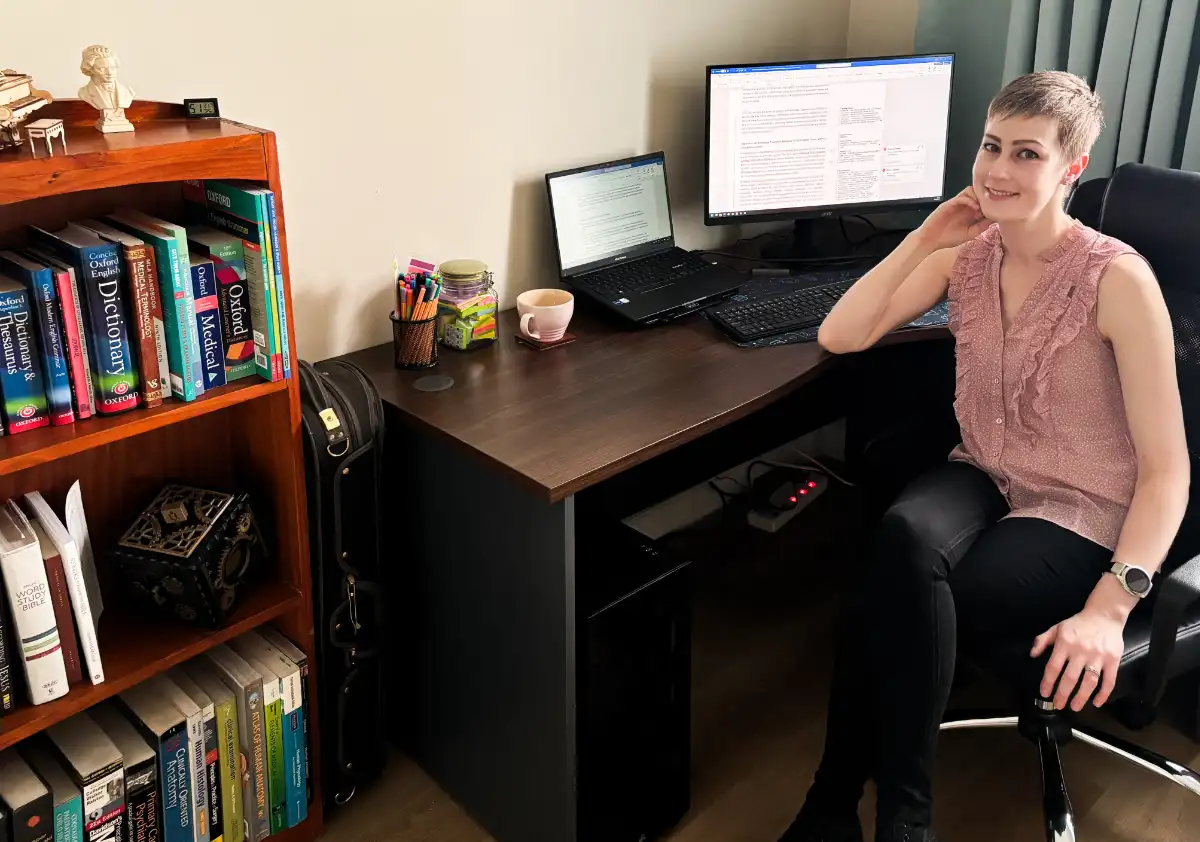
Sharné Denner is a freelance copy-editor and proofreader with a rare combination of credentials: a medical degree paired with formal editorial training.
After completing her medical qualification and a postgraduate diploma in clinical trial management, Sharné discovered that her true calling lay in the precision and craft of language. She retrained as a copy-editor through SA Writers’ College, completing both the Copy-editing and Proofreading Course and the Advanced Grammar Course, followed by a formal editorial internship. She is a member of the Professional Editors’ Guild (PEG) of South Africa.
Sharné now works as a freelance copy-editor across fiction and non-fiction, bringing a depth of subject-matter expertise to medical journals that few editors can match.
Contact Sharné for editing work at sharnedenner@gmail.com.