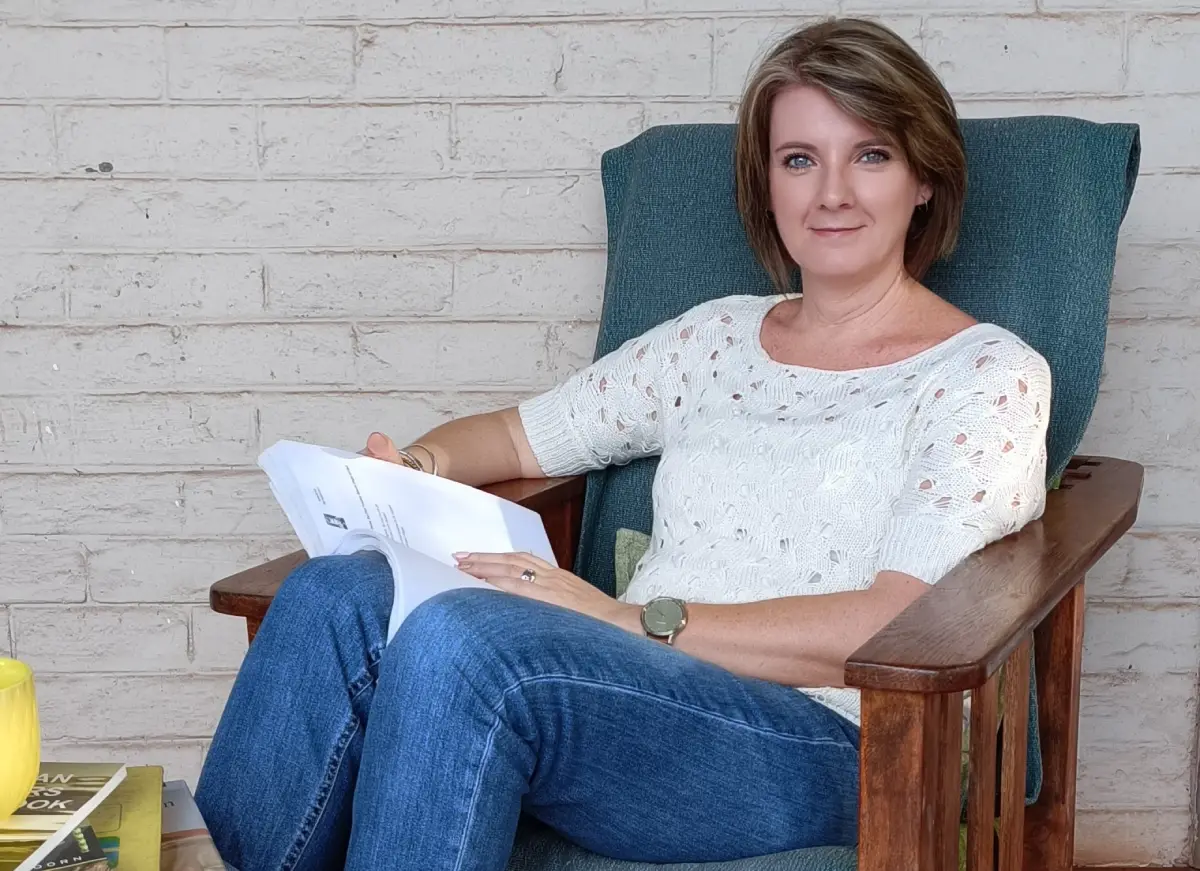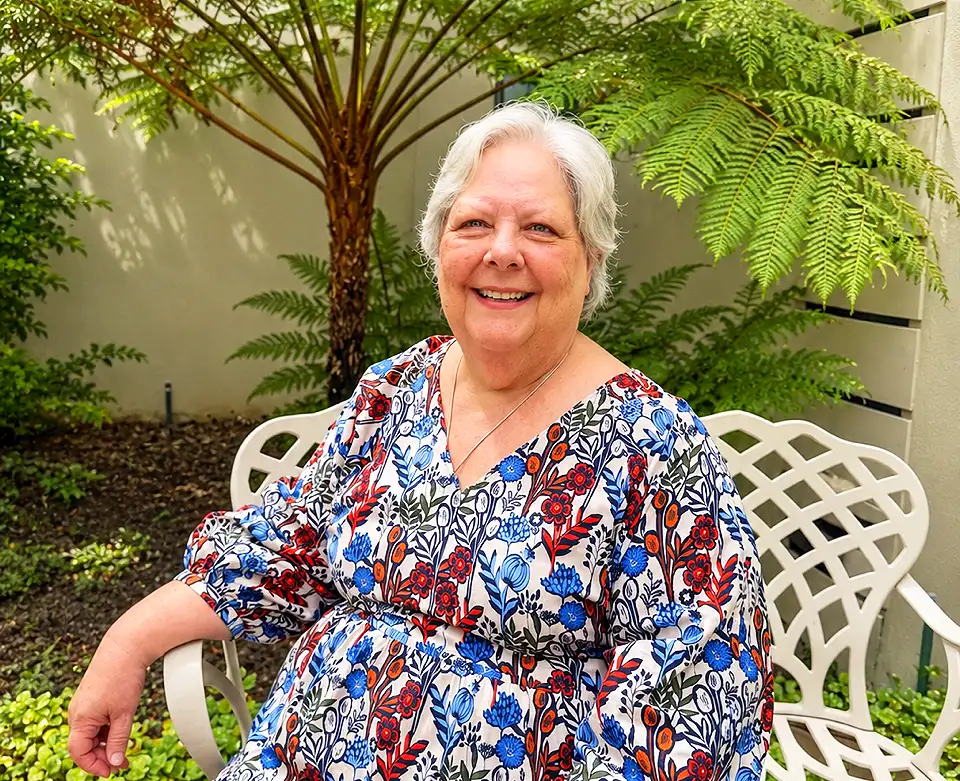
Award-winning author and long-time SA Writers’ College tutor Helen Brain has spent a lifetime asking questions. Whether she’s browsing charity shops, teaching aspiring writers or learning to draw at 65, it’s curiosity that continues to shape her creative life.
Ask Helen Brain what inspires her stories, and the conversation quickly turns to the world around her. She’s as interested in everyday details as she is in life’s bigger questions.
‘Take thrift shops, for example,’ she says. ‘I’m fascinated by the stuff in thrift shops – why do people give things of value away?’
This innate curiosity has fuelled Helen’s writing career, during which she has published more than 60 books and received numerous literary accolades.
In 1998, Helen won an ATKV Award for her novel Tamara. Noem my Kat was a runner-up for the same award in 2001. Three of her books have been selected for the South African Children’s Book Forum Honours List, and in 2006, she was nominated for a Women Demand Dignity White Ribbon Award.
Since 2007, she has guided thousands of aspiring writers through SA Writers’ College, where she tutors the Basics of Creative Writing Course and the Write a Children’s Book Course.
Not that Helen is one to dwell on her achievements. She’s far more interested in talking about the people, ideas and observations that inspire her creativity.
Writing through difficult questions
Although Helen is primarily a fiction author, her writing has also led her into difficult personal territory. Her adult memoir, Here Be Lions, was a book she felt compelled to write, although its publication carried painful consequences.
‘It was a terrible thing, that book,’ she says. ‘I had to do it, but it fractured my family. It was a cost I had to pay, but I really regret the hurt it caused my siblings.’
Time and reconciliation have helped repair those relationships, but the experience changed the way she views memoir.
‘I’ve apologised to them now and we are friends again, which is fantastic. But it was very hard. I would advise anyone who publishes a memoir to be very careful because the consequences can be devastating, not only for you but for the innocent people caught in the crossfire.’
In 2015, Helen began writing her Elevation trilogy, which allowed her to examine questions that remained unresolved following the passing of her first husband.
‘My first husband died of cancer when he was 48. It really shattered my sense of God and of the world being a good place. I wasn’t a believer at that point. I’m still not really a believer. What I wanted to do in the series was explore what God meant to me and why bad things happen to good people.’
Those questions became intertwined with Helen’s growing concern about the environment and humanity’s treatment of the natural world.
‘The real spiritual issue for me is why we have damaged the world so appallingly and how we come to terms with that,’ she explains. ‘I wanted to write about what happens when it has all been destroyed, when people start grabbing onto things and making stockpiles.’
Since then, increasingly severe storms, conflict, displacement and environmental destruction have made parts of the trilogy’s imagined world feel uncomfortably close.
‘So much of it has come true,’ Helen says. ‘We’re so clearly heading towards an ecological disaster that it’s quite disconcerting.’
Teaching creative writing
As a tutor, Helen believes that good fiction begins with a writer’s ability to engage readers emotionally. One of her most memorable students struggled with spelling, grammar and confidence but had something Helen considered far more important.
‘Their ability to tell a ripping good yarn was brilliant,’ she recalls. ‘You can have all the PhDs in the world, be a brilliant grammarian, know how to parse every verb and spell every word. But if you can’t tell a good story, you aren’t going to pull in a reader.’
A talent for storytelling, however, is only part of the equation. According to Helen, perseverance and the desire to succeed often determine who completes a manuscript and who does not.
‘You’ve got to have grit,’ she says. ‘You’ve got to keep your bum on the chair and keep going. If you lined up everyone from the most talented to the least talented, the ones who make it to the far side are the ones with grit.’
Her advice is practical: make the task smaller, work consistently and resist the temptation to give up.
Developing a creative writing course
Helen’s own perseverance was tested during her husband’s illness.
‘I realised I was going to have to double my income, and then we realised he was going to die. I had three children, two of whom were still teenagers and living at home. I had to find a way to support myself and my family.’
At the time, she was already tutoring the Write a Children’s Book Course, but she had noticed that many students first needed help with the foundations of creative writing. She approached Nichola Meyer at SA Writers’ College with the idea of developing a course devoted to those essential skills.
‘When people came to do the children’s book course, some of them didn’t have basic writing skills. I thought that if I could create a course that taught those foundations, it would really help them.‘
The resulting Basics of Creative Writing Course became enormously successful and transformed Helen’s circumstances.
‘That course really took off. I’m proud that with a few tweaks here and there, people can improve their skills and get what is in their heads onto the page more effectively.’
Learning to illustrate
After decades of writing, Helen is now exploring another form of storytelling by teaching herself to illustrate.
‘I want to tell stories in a different way,’ she explains. ‘I’m hoping to become a picture-book writer, so what I do all day is draw and think about how I would tell a story visually as well as verbally.’
Drawing gives Helen’s long-held habit of observation another outlet.
‘Learning to draw has made me so flipping happy because now I look at things. When I go to the coffee shop, I don’t sit on my phone. If you’re learning to write and you don’t want to draw, sit and write what you see. Look at how people are leaning into each other and what their relationship is saying. Focus on what is actually there.’
Helen is also starting a YouTube channel to document her progress as an illustrator.
‘I wish I had videos of my grandparents, my father and particularly my late husband. I don’t have any videos of him, and it’s heartbreaking,’ she says. ‘What I’m really doing with my YouTube channel is talking to my grandchildren. I want my children and grandchildren to be able to find it one day.’
At 65, Helen has simplified her surroundings, reconsidered her consumption habits and now focuses on what truly matters to her.
‘The older I get, the more grounded I become. I think I probably have ten good years, maybe 15 if I’m lucky, so how do I want to spend them?’
‘You’ve got to have grit. You’ve got to keep your bum on the chair
and keep going.’ ~ Helen Brain
As Helen explores a new medium, curiosity remains central to her creativity. As she puts it: ‘The real world is out there, and drawing lets me sit and look at it.’
Helen reminds us that creativity is not about reaching our destination; it’s about remaining curious enough to keep exploring.