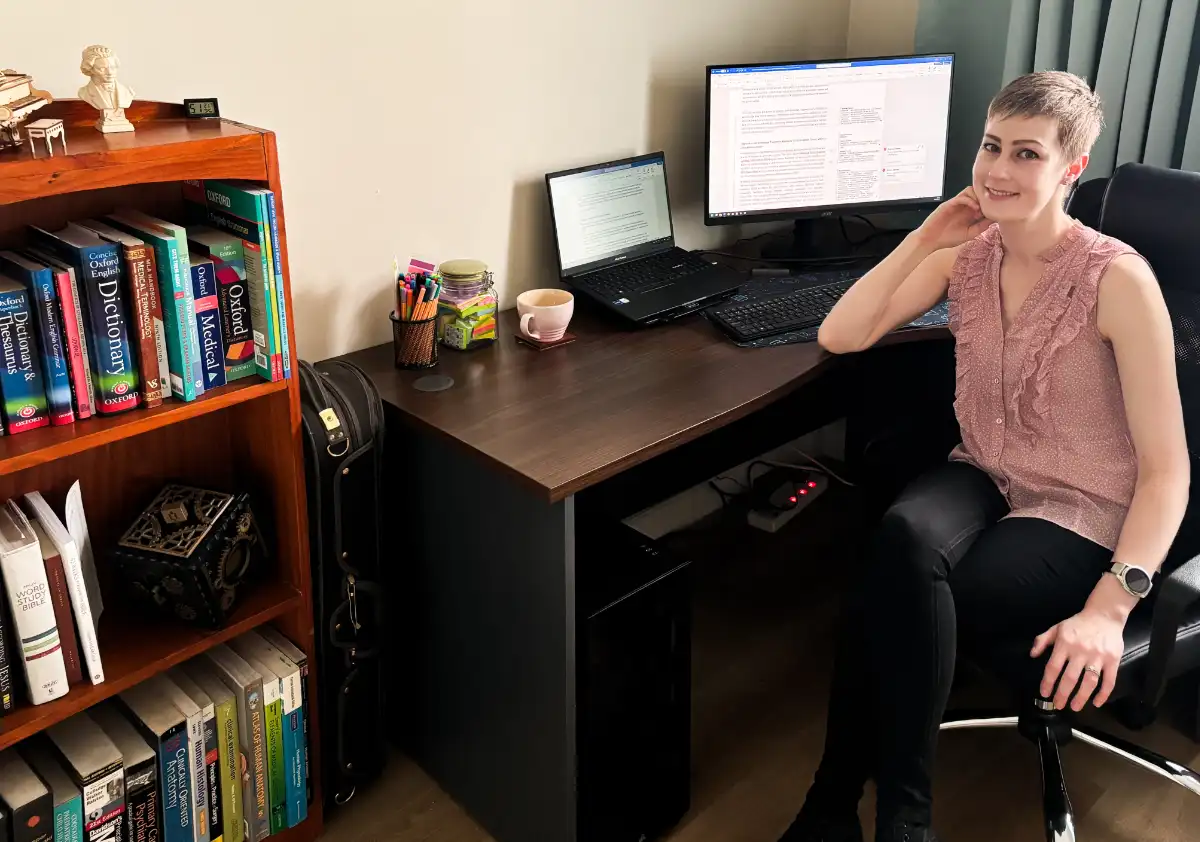
If you want to work from home with hardly any overheads or money to get started, a writing career is a viable option for those who are willing to work hard, stick to deadlines and keep their writing skills impeccable and up to date.
keywords: make money in south africa, make money from home, make money using phone
Remember the days of dial-up modems, Telkom bills, ring binders and cheques in the post for freelance work? Few could have imagined then how things would change a mere 20 years later.
Now the bulky PC is a laptop and the binder is a folder in the cloud. A notification pings: a client in Toronto, found through Fiverr, has paid for 1 500 words on home insurance. Another, in London, has just approved a batch of product descriptions. The money lands in PayPal, and a few clicks later, it’s on its way to your FNB account.
Thanks to Upwork, Fiverr and other global platforms, South African writers now work for clients across the world. Whether it’s copywriting, SEO web content, editing and proofreading, article writing, scriptwriting or publishing your novels on Amazon, the writing market is now truly global.
What is driving demand?
The creator economy and digital monetisation: Across South Africa, a growing wave of ‘creator-entrepreneurs’ is treating writing as a scalable income stream. People are enrolling in courses to learn how to build newsletters, scripts, podcasts and e-books: formats that require minimal overhead and allow local writers to reach global audiences.
Workplace upskilling and AI editing: As AI-generated text floods the market, South African businesses and freelancers tend to place higher value on authentic human storytelling, voice and critical editing. Mid-career professionals in marketing, PR and communications increasingly take writing courses to sharpen their narrative skills and stand out.
Growth in local film, TV and publishing: Baseline research put the film and TV industry’s GDP contribution at about R3.5 billion annually, driving steady demand for scriptwriters. Simultaneously, accessible self-publishing platforms and a vibrant local literary scene (spanning English, Afrikaans and indigenous languages) continue to motivate aspiring novelists.
Self-publishing is now a viable way to make money: The growth of self-publishing and digital publishing on Amazon and other publishing platforms has created clear demand for practical training. For instance, SA Writers’ College offers a Self-Publish Your Book Course.
Fintech has transformed how South Africans can receive overseas payments
- Wise lets South African users receive money with their own account details in several top currencies, and offers a rand balance for local transfers.
- Grey is a platform built specifically to simplify receiving international payments for South African freelancers, issuing local-style GBP account details such as a sort code and account number once verified, and offers the same for USD, GBP and EUR more broadly.
- Payoneer is widely used in South Africa for international business payments, letting freelancers and businesses receive funds from overseas.
Who is hiring South African writers?
The freelance writing landscape in South Africa has split into two distinct tracks: local digital marketing for South African SMEs and agencies, and high-earning remote exports where local writers leverage native English proficiency and overlapping time zones to earn USD or GBP from UK, US and European clients.
Because AI tools can easily create generic, low-cost blog posts, the highest demand and best rates are concentrated in specialised, research-heavy and conversion-focused niches.

From award-winning, best-selling novelists to 500+ jobs on Fiverr
See how SA Writers’ College students are performing in the writing industry
What are the top in-demand writing niches?
South African rates vary widely. The Safrea 2026 Freelance Media Industry and Rates Report, based on responses from more than 400 freelancers, reports R400–R500 per hour as the most frequently cited rate for general non-fiction writing and R600–R900 per hour for technical or specialist content. These figures are benchmarks rather than fixed rates; SEO, B2B/SaaS, AI editing and international copywriting rates can differ substantially by experience, niche, client and project scope.
1. High-Value B2B & SaaS Writing
Business-to-business (B2B) and Software-as-a-Service (SaaS) companies, particularly international startups and tech firms, actively hire South African freelancers to create deeply researched content that AI cannot easily replicate.
- Deliverables: White papers, customer case studies, product explainers, onboarding guides and technical blog posts.
- What it pays: International B2B and SaaS clients may pay substantially more for research-led, conversion-focused or technical content than for general blog writing. As a rough illustration, experienced specialist writers may quote from about $150 to $500+ per article, or approximately $30–$45 per hour, depending on the brief, research requirements, client budget and writer’s experience. These are estimates, not standard rates
Relevant courses: Write Better Company Newsletters | Writing Articles for Websites and Blogs | Business Writing Toolkit
2. Finance, Fintech & Legal Content
With South Africa’s sophisticated banking, insurance and fintech sectors (alongside high global demand), writers who can translate complex financial or regulatory concepts into clear, trustworthy prose are consistently sought after.
- Deliverables: Personal finance guides, investment and crypto explainers, insurance copy and legal research/rankings articles.
- What it pays: Financial brands often prioritise accuracy, credibility and subject-matter knowledge. Safrea’s 2026 report found that technical and specialist content was most frequently reported at R600–R900 per hour, with a weighted average of R500–R600 per hour; highly specialised work may command more. Rates vary with expertise, research requirements and compliance risk.
Relevant courses: Freelance Journalism for Magazines and Webzines
3. SEO Content & Conversion Copywriting
Local digital marketing agencies and growing South African SMEs rely heavily on freelancers to handle their ongoing online presence rather than hiring full-time staff.
- Deliverables: Search-optimised website copy, landing pages, email marketing sequences and product descriptions.
- What it pays: South African web and SEO content writers may charge from about R200 to R600 per hour, depending on experience, specialisation and client type. Entry-level or high-volume work may fall below this range, while experienced conversion copywriters with strong SEO and persuasive-writing skills may charge more. Safrea’s 2026 report found general non-fiction writing was most frequently reported at R400–R500 per hour
Relevant courses: Writing SEO Copy for Websites | Copywriting
4. AI Content Editing & Prompt Strategy
As companies adopt generative AI for first drafts, a rapidly growing niche has emerged around human-in-the-loop quality control.
- Deliverables: Fact-checking, rewriting robotic AI copy to match brand voice, developing brand style prompts and managing editorial workflows.
- Why it’s growing: Businesses may find that unedited, generic or inaccurate AI output undermines credibility and reader trust. This can create demand for research, fact-checking, editing, brand-voice work and editorial oversight.
- What it pays: Safrea’s 2026 report found copyediting/subediting was most frequently reported at R400–R500 per hour, while proofreading and fact-checking were most frequently reported at R300–R400 per hour.
Relevant courses: Write with AI | Copy-editing and Proofreading
5. Technical & Healthcare Writing
Industries such as engineering, software, pharmaceuticals and private healthcare require writers who can simplify dense, regulated material for everyday readers or professionals. A degree in the specialised field is required, as well as writing training.
- Deliverables: Instruction manuals, standard operating procedures (SOPs), patient education articles and wellness brand copy.
- What it pays: Safrea’s 2026 report found technical/specialist content was most frequently reported at R600–R900 per hour, with a weighted average of R500–R600 per hour. Actual rates depend heavily on subject expertise, research requirements, regulatory knowledge and project complexity.
Relevant courses: Freelance Journalism for Magazines and Webzines
6. Niche Newsletters, Ghostwriting & Scriptwriting
- Executive Ghostwriting: Writing thought-leadership articles, books and LinkedIn content for founders, executives and consultants.
- Hyper-Local Creator Brands: Building specialised South African newsletters or YouTube scripts (covering local property, solar/off-grid living or local investing) monetised via sponsorships.
- Scriptwriting: Writing scripts for YouTube creators, corporate explainers and South Africa’s active film and television production sector.
Relevant courses: Write Better Company Newsletters | Scriptwriting | Writing Articles for Websites and Blogs | Write a Non-Fiction Book
7. Self-publishing Books on Amazon
Coral Hart, a South African author publishing under a pseudonym, has publicly estimated that she earned more than US$1 million from book sales in 2026 and sold more than one million copies across digital, print and audio formats. These figures are self-reported. Furthermore, they should not be treated as a typical outcome for self-published authors. Many self-published authors earn very little from their books.
Here’s what South African authors can do:
- Create a free KDP account and publish an eBook, paperback or hardcover.
- Sell internationally by choosing worldwide distribution rights, provided the author owns or has cleared the necessary rights.
- Receive royalties by direct deposit into a South African bank account.
- Choose between KDP’s 70% or 35% eBook royalty options, subject to the book’s price, format and distribution settings. Royalties for print books are less.
Relevant courses: Self-Publish Your Book | Write a Novel | Skryf ‘n roman
Quick Comparison of Top Niches
| Niche | Primary Client Base | Typical Rate Range (rough estimates) | Barrier to Entry |
| B2B & SaaS | UK, US & EU tech companies | $150–$500+ per piece | Moderate–High (requires skills & portfolio) |
| Finance & Fintech | Banks, insurers & fintech startups | R500–R900/hr (or USD equivalents) | High (requires fintech knowledge/degree) |
| SEO & Web Copy | Local SA SMEs & marketing agencies | R200–R600/hr | Moderate (requires strong SEO and writing skills) |
| AI Editing & Strategy | Agencies & content-heavy brands | R300–R600+/hr | Moderate (requires strong editing skills) |
| Creative Writing | Local or global readers | Dependent on book sales: $1+ | Moderate–High (Training is required to write quality novels, as well as self-publishing know-how) |
The practicalities of making money as a writer
Landing international clients in the UK or US from South Africa works best when you combine frictionless international payment infrastructure, niche positioning and targeted direct outreach rather than competing on price in overcrowded bidding wars on freelancing platforms.
As a South African writer, you hold two strong competitive advantages: native-level English proficiency and a time zone (SAST) that overlaps cleanly with the entire UK business day and the US East Coast morning.
- Set up international payment infrastructure first: Do this before pitching so you never lose a client over payment friction. US and UK companies may expect to pay via local bank transfer (ACH in the US, Faster Payments in the UK).
- Open a multi-currency account: Platforms like Wise, Payoneer or Grey give you virtual USD and GBP bank details.
- Result: A client in London or New York pays you like a local contractor, and you withdraw the funds to your South African bank account at competitive exchange rates.
2. Lock in one high-value niche and build 3–5 targeted samples: International clients rarely hire generalist ‘blog writers’. They hire specialists who understand their industry.
- Pick a lucrative lane: B2B SaaS, fintech, healthcare, e-commerce or AI content editing.
- Mirror their market: Write 3 to 5 spec samples tailored specifically to UK or US audiences. Match their spelling conventions (US vs UK English) and reference local regulations, brands or data so your work looks indistinguishable from a local writer’s.
- Host professionally: Put your samples on a clean personal website, Notion page or LinkedIn profile. Avoid relying solely on social media feeds.
3. Use marketplaces to build initial social proof: Focus on your first 90 days.
If you have zero international testimonials, start on a platform that handles escrow and trust for you.
- Where to focus: Upwork (largest volume of US clients) or PeoplePerHour (strong UK and European client base).
- The 90-day goal: Pick one platform, optimise your profile around your niche and land 3 to 5 projects to collect verified 5-star reviews from US/UK buyers before raising your rates.
- Hunt ‘writer callouts’ and decision-makers on LinkedIn: 20–30 minutes daily.
The highest-paying contracts are rarely listed on job boards; they are filled through direct connections.
- Optimise your headline: State exactly who you help (e.g., ‘B2B SaaS Content Writer for UK & US Tech Companies’).
- Search for live callouts: Search LinkedIn posts (sorted by Latest) for phrases like ‘looking for freelance writers’, ‘hiring B2B writer’ or ‘freelance fintech writer’.
- Connect directly: Send connection requests to Heads of Content, Content Marketing Managers and Editorial Directors at companies in your niche. Engage thoughtfully with their posts before pitching.
- Send short, value-first cold pitches to agencies and brands: Small UK and US content marketing agencies frequently overflow with client work and rely on reliable external contractors.
- Build a prospect list: Use directories like Clutch or Google searches (‘B2B content marketing agency London’ or ‘SaaS content agency New York’) to find boutique agencies.
- Find the right contact: Use LinkedIn and email-finder tools (like Hunter.io or Apollo) to reach the Editorial Director or Account Manager.
- Keep the pitch under 120 words: Mention one specific observation about their recent content, link 2 relevant samples, note your time zone overlap and ask if they keep a roster of freelance writers for overflow work.
Because of high commissions and “race-to-the-bottom” pricing on open marketplaces, many experienced writers now treat Upwork and Fiverr as secondary lead sources and rely on other platforms. Here are ways to find work once you have established your portfolio and garnered some positive reviews:
| Platform / Channel | Best For | Key Advantage |
| B2B, corporate, copywriting & retainers | No middleman or commission fees; inbound leads from optimizing your profile and networking directly with editors and marketing managers. | |
| Contra | Portfolio-driven & tech/startup writers | 0% commission for freelancers (clients pay the platform fee), modern portfolio hosting, and higher minimum project rates. |
| Curated / Vetted Networks (e.g., Contently, ClearVoice, WriterAccess) | Experienced journalists & niche specialists | Higher corporate budgets and pre-vetted clients, though acceptance is highly selective. |
| Niche Job Boards & Newsletters (e.g., ProBlogger, Peak Freelance, Superpath, Freedom With Writing) | Content marketing, SaaS & journalism | Direct applications to companies hiring writers without platform markups or bidding wars. |
| AI Training & Editorial Platforms (e.g., Mindrift, DataAnnotation) | Writers skilled in research, editing & fact-checking | Steady hourly project work evaluating, rewriting, and fact-checking generative AI outputs. |
Key habits that keep international clients on retainer
- Eliminate time zone anxiety: Mention upfront that you work SAST, meaning your afternoon overlaps with US morning hours and your full day aligns with the UK.
- Master async communication: Over-communicate progress before deadlines, use Loom videos to walk through complex drafts and always deliver 24 hours early when starting out.
- Price in their currency: Quote flat per-project or per-article fees in USD ($) or GBP (£) rather than converting from Rand. This anchors your value to their local market rates rather than South African living costs.