South African newsrooms are under severe financial pressure, but digital technology is transforming how journalism is produced and creating new opportunities for journalists to use their skills both inside and beyond the newsroom.
Few people are better placed to discuss the future of South African journalism than Adriaan Basson. With more than two decades in the newsroom, he has seen the profession move from print deadlines to digital immediacy, from traditional reporting rhythms to an always-on media ecosystem.
An award-winning investigative journalist and author of four books on corruption and current affairs, Basson began his career at Beeld in 2003 before moving into investigative reporting at the Mail & Guardian. He later became a founding member of amaBhungane, served as assistant editor of City Press and returned to Beeld as editor in 2013.
A recipient of the CNN African Journalist of the Year Award for news and the Taco Kuiper Award for investigative journalism, Basson was appointed editor-in-chief of News24 in 2016, a role that places him at the centre of South Africa’s shift from print-era journalism to subscription-led digital news.

South African newsrooms under pressure
When asked what has changed in journalism and newsrooms over the past decade, Basson replies, ‘Everything.’
The transformation, he explains, has brought both exciting opportunities and formidable challenges, a tension that now defines the profession for young journalists trying to decide whether the newsroom is still a place to build a future.
For anyone contemplating journalism as a career, the picture in South Africa is complicated. Professional newsrooms are shrinking, but journalistic skills, including research, interviewing, verification, storytelling and making sense of complex information, are increasingly valuable across digital media and beyond the newsroom.
That matters because professional newsrooms are built around authentication, editorial oversight and accountability. Much social-media content reaches the public without the same checks, making credible journalism more necessary even as the industry that produces it faces mounting pressure.
What has happened to traditional journalism?
Digital media has moved to the centre of news consumption, accelerating the decline of print and reshaping how journalists gather, package and distribute stories.
On the positive side, Basson explains: ‘Digital platforms have given us enormous exposure, far more than we ever had in print. A story can now be viewed or heard by thousands of people around the world, instead of being confined to a physical product.’
Those platforms also allow journalists to combine text, audio, video, graphics and data visualisation such as mapping links in a corruption investigation or reconstructing the scene of a crime.
‘In the past, obtaining geographical data, flight plans, Deeds Office documents or court records, for example, was difficult. Today, much of that information is easier to access.’
‘Professional journalists must understand and follow the principles of the Press Council of South Africa, including reasonableness, fairness and truth. Many independent reporters and content creators do not subscribe to the Press Code, or to any code of ethics at all.’
‘Journalists now operate in a broader content ecosystem. What should distinguish them is the time, discipline and resources they invest in establishing the truth.’
‘The challenge for the public is to distinguish fact from fiction. A street sweeper who owns a cell phone can report on the latest developments in a court proceeding, but that is probably not the most reliable source from which to obtain your news.’
News24 has responded by strengthening its emphasis on credible, high-quality reporting.
‘At News24, we decided to double down on quality journalism. We must be distinctly different from the content circulating on YouTube, Instagram and TikTok: factual, fair, well written and grounded in strong narrative writing.
‘In fact, we took this so seriously that at News24 we changed our tagline from “Breaking News. First” to “Trusted News. First”.’
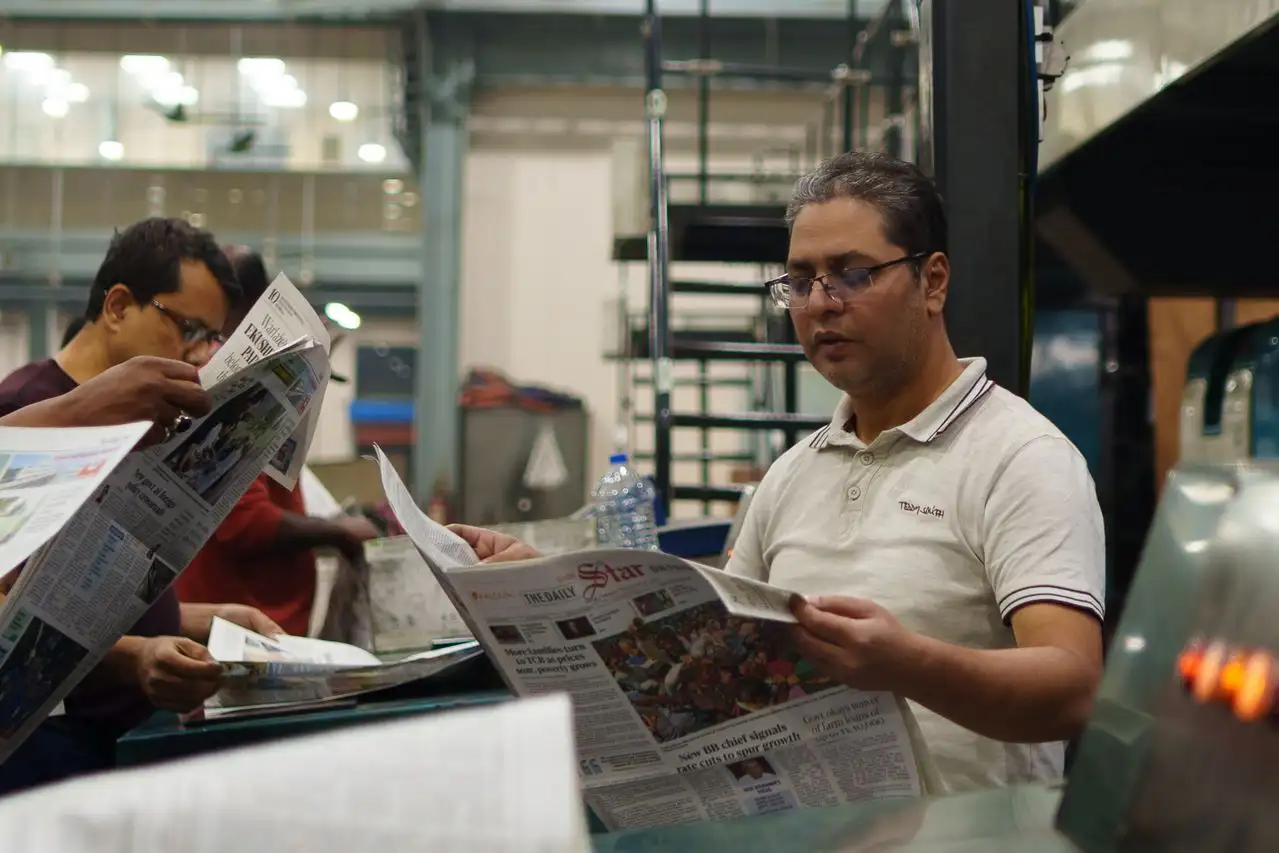
Print decline at a glance: Circulation changes among selected South African newspapers.
| Title | 2014 circulation | 2024 circulation | % reduction |
| Die Burger | 57,423 | 25,668 | 55.30% |
| The Citizen | 57,096 | 20,786 | 63.59% |
| The Star | 96,029 | 20,124 | 79.04% |
| Isolezwe | 104,860 | 19,890 | 81.03% |
| Beeld | 59,544 | 18,865 | 68.32% |
| Sowetan | 99,529 | 17,141 | 82.78% |
| Business Day | 30,901 | 13,092 | 57.63% |
| The Herald | 22,987 | 11,407 | 50.38% |
| Daily Sun | 274,165 | 11,046 | 95.97% |
| Daily Dispatch | 26,915 | 10,553 | 60.79% |
Note: These figures are indicative estimates compiled from recent industry data, reported averages and market projections. Actual circulation figures may vary according to the source, methodology, reporting period, currency fluctuations and market conditions. The figures should therefore be interpreted as broad trends rather than audited financial results.
Source: Audit Bureau of Circulations (ABC) Q2 2014 and Q2 2024 circulation data. 2014 figures reported by MarkLives; 2024 figures reported by Bizcommunity. Percentage reductions calculated from the respective circulation figures.
For a detailed examination of how digital technology and online platforms have transformed South African journalism, read the Competition Commission’s Media and Digital Platforms Market Inquiry: Final Report.
Credibility is becoming a competitive advantage. Basson states, ‘The best compliment I have ever received was when someone said, “If we want to find out whether something is true, we check News24.”’
Would Basson still recommend journalism as a career?
Basson admits that the question prompted ‘a whole existential thought process’.
‘Every muscle in my being wants to say yes, but I also need to be realistic. Let me qualify my answer by saying: absolutely, provided you are bold enough to face the challenges confronting the industry, naturally curious and determined to discover what people may be hiding.
‘You must want to shine a spotlight on the things that are damaging society, and you must be comfortable knowing that you may eventually find yourself occupying some form of activist space. If that matches your personality, then there is nothing better than journalism.’
He acknowledges, however, that pursuing journalism as a career is not without risk.
‘Many media organisations have conducted extensive retrenchments.
‘You have to be fully committed to the cause of telling the truth, no matter what.’
‘If you are a young student studying towards an undergraduate degree in journalism, I would recommend that you start practising immediately through social media. Make potential employers notice you and your work. Go to the courtrooms, produce some videos and start putting yourself out there.
‘You have to hustle a bit to get going.’
That tension is reflected in wider newsroom research too: South African journalism is under pressure, but trust, resilience and adaptability remain central to its future. For further context, see State of the Newsroom 2025, Wits Centre for Journalism.

Where the strongest opportunities lie
If journalism remains worth pursuing, the strongest opportunities will belong to people who combine traditional reporting discipline with the ability to work across digital platforms.
Basson cautions against treating ‘traditional journalism’ as an outdated category. To him, the real distinction is not between old and new platforms, but between responsible reporting and unverified content.
‘People love to criticise legacy media, but when I refer to traditional journalism, I mean proper, ethical reporting. That applies irrespective of platform, whether it is a conventional news desk, TikTok, Facebook or Instagram.’
The opportunity, then, is not to abandon core reporting skills, but to use technology to make those skills more visible, versatile and valuable.
Basson puts the priority clearly: ‘I think this is at the core of it: if I send you to cover the Budget Speech or the State of the Nation Address, I don’t care whether you are a great videographer or drone pilot. I need you to listen to the content, understand it, make sense of it and translate it into accessible language so that even your mother can understand it.’
In practical terms, this could include:
- Multimedia reporting: Recording and editing video, audio and photographs; producing podcasts; conducting livestreams; and creating short-form news videos.
- Mobile journalism: Using a smartphone to film interviews, record audio, photograph events and publish reports directly from the scene.
- Digital verification: Checking social-media posts, images, videos and documents through reverse-image searches, geolocation, metadata analysis and source verification.
- Artificial intelligence: Using AI to transcribe interviews, search large documents, analyse data, generate summaries and assist with editing, while independently verifying its output and protecting confidential information. Reuters, for example, says AI may assist with reporting, editing, production and publishing, but remains subject to editorial oversight.
- Social-media distribution: Adapting stories for YouTube, TikTok, Instagram, Facebook, X and WhatsApp, rather than simply reposting the same article on every platform.
- Audience analysis: Using analytics to understand how readers discover stories, how long they engage with them and which formats are most effective, without allowing popularity to override news value.
- Online publishing: Working with content-management systems, newsletters, live blogs, push notifications, search optimisation and AI-driven discovery platforms.
- Cybersecurity: Protecting sources and sensitive information through strong passwords, two-factor authentication, encrypted communication and secure document storage.
‘The best compliment I have ever received was when someone said, “If we want to find out whether something is true, we check News24.”’
— Adriaan Basson
He warns that sensational content, when rewarded over accuracy, can weaken public trust and could ultimately affect our democracy.
That focus on trust also has a business dimension: Basson says News24’s subscription model is helping the organisation respond to financial pressure by encouraging readers to pay for quality journalism instead of relying only on scale and advertising.
Media platform trends: Growth and pressure points across selected South African media categories.
| Medium | Approx. Recent Revenue / Scale | % Growth (YoY / recent trend) |
| Digital (overall / digital newsrooms) | ~R17.7bn in 2023, growing to ~R33.6bn by 2025/26 | +10% to +12% (strong; was +21.5% in 2023) |
| Radio | Part of broader audio segment | +2% to +4% (modest positive / relatively resilient) |
| Television | Traditional TV still significant | 0% to -3% (flat to mild decline; linear under pressure, digital/OTT growing) |
| Newspapers | Print continuing to shrink | -2% to -5% (clear decline; print harder hit than digital extensions) |
Note: These figures are indicative estimates compiled from recent industry data, reported averages and market projections. Actual revenue and growth rates may vary according to the source, methodology, reporting period, currency fluctuations and market conditions. The figures should therefore be interpreted as broad trends rather than audited financial results.
Sources: IAB South Africa/PwC for digital advertising; Competition Commission’s Media and Digital Platforms Market Inquiry for print and television trends.
The corporate pull: Why journalists are leaving the newsroom
Journalists are trained to absorb complex information quickly, identify what matters and communicate it clearly and accurately to different audiences, abilities that are highly valued by corporate employers.
Their experience with digital publishing, social media, multimedia production and audience engagement makes them valuable in B2B marketing, corporate communications, public relations, content marketing and crisis management.
Above all, journalists know how to create credible narratives that strengthen an organisation’s identity and build trust.
Basson expresses concern: ‘Yeah, we’ve lost many top journalists to the corporate sector. The money is just better. Apart from the money, you need a thick skin in this game. Many people don’t have that and leave after being abused on social media.’
For a detailed examination of the corporate pull, read Glenda Daniels’s study, Traumatic Transitions and Loss: How Journalists in South Africa Experience Job Loss.
The journalism/corporate salary gap: Indicative salary comparisons across newsroom, content and communications roles.
| Career route | Approx. SA salary | What it tells us |
| Newsroom journalist | R15,322/month average Approx. R184,000/year | This is the current broad national average. The reported range is roughly R9,872 to R23,780/month, showing that early newsroom journalism can be financially modest and uneven. |
| Journalist at major media employers | Media24: ~R333,000/year eNCA: ~R390,000/year | Larger, established media organisations can pay substantially above the general journalist average, but these roles are likely to be more competitive. |
| Digital/content producer | R12,246/month average Approx. R147,000/year | Moving into generic digital content does not automatically mean earning more. The strongest opportunities are likely in specialist, strategic or commercially valuable content roles. |
| Social media content creator | R18,000 to R25,000/month | This suggests stronger earning potential than some generic content-production roles, especially where social media work includes audience strategy, video and campaign skills. |
| Communications & PR officer | R31,667 to R35,000/month Approx. R380,000 to R420,000/year | This is where journalism’s transferable skills, including research, writing, interviewing, media judgement and accuracy, can become considerably more valuable outside the newsroom. |
| Communications manager | R32,998/month average Approx. R396,000/year | This is more than twice the broad journalist average, although it is usually a more senior role requiring management, planning and stakeholder-communication skills. |
| Marketing manager | R35,000 to R68,163/month | The earning ceiling rises significantly when journalistic skills are combined with commercial awareness, branding, content strategy and campaign management. |
| Podcast/video/multimedia | Highly variable | Salaried multimedia jobs exist, but independent income often depends on sponsorship, advertising, subscriptions and freelance work, making a single reliable average difficult to establish. |
Note: These figures are indicative estimates compiled from recent industry data, reported averages and market projections. Actual salaries may vary according to the source, methodology, reporting period, currency fluctuations and market conditions. The figures should therefore be interpreted as broad trends rather than audited financial results.
Source: Pnet 2026 Salary Guide. Salary ranges are monthly cost-to-company figures derived from vacancies advertised on Pnet.
The battle to become an AI-cited source
The same shift that has disrupted newsroom economics is also opening a newer opportunity: producing authoritative, clearly structured journalism that can be discovered and cited through AI-powered search.
This connects directly to the discipline Basson describes. Precise headlines, strong openings, accurate information and clear attribution remain essential, but online journalism must now also be structured so that readers, search engines and AI-powered tools can identify why a source is credible.
For further guidance, read Google’s Guide to Optimizing for Generative AI Features.
‘I think this is at the core of it: if I send you to cover the Budget Speech or the State of the Nation Address, I don’t care whether you are a great videographer or drone pilot. I need you to listen to the content, understand it, make sense of it and translate it into accessible language so that even your mother can understand it.’
— Adriaan Basson
For aspiring journalists, South Africa offers a difficult but still worthwhile career path. Newsroom opportunities are fewer, and building a career requires persistence, adaptability and a realistic understanding of the financial pressures.
The skills developed through journalism also open doors beyond reporting. Researching thoroughly, asking useful questions, verifying information and explaining complex subjects clearly remain valuable across media and corporate work.
The career may change. The responsibility to make sense of the world remains.

About the Author

Phil Beley is a South African based writer and journalism intern with the SA Writers’ College. A former marketing director with 17 years’ experience in logistics, he brings a business perspective to his writing on journalism, publishing and building sustainable careers in a changing media industry. His interests include conservation and adventure motorbiking.