South Africa has produced two Nobel laureates in literature, Nadine Gordimer and J. M. Coetzee, alongside Booker Prize winners, a thriving Afrikaans literary tradition and twelve official languages’ worth of stories still waiting to be told. Here are resources to help you on your literary way.
Nadine Gordimer herself described the task plainly: ‘Writing is making sense of life. You work your whole life and perhaps you’ve made sense of one small area.’ That is the work ahead of every writer reading this, whether you’re drafting a novel, a memoir, an academic article or your first short story.
Talent alone rarely gets a manuscript finished, let alone published. What closes the gap is the right support at the right moment: a course that teaches structure, a community that keeps you accountable and a publisher willing to read what you send them. South Africa has a genuinely rich, if sometimes under-advertised, ecosystem of exactly this kind of support, spanning fiction and non-fiction alike.
Essential writing tools and software
The right software can streamline your process and sharpen your work, and South African writers reach for the same global tools everyone else does, since good software has no borders.
Scrivener helps you organise research, outlines and drafts, set goals and track progress, all in one place, and is especially popular with novelists. Editing software such as Grammarly and ProWritingAid catches grammar and punctuation errors and suggests style improvements, though neither should replace a careful proofread, and neither is tuned to South African English, so treat their suggestions as a starting point rather than the final word. Beyond these, task-specific tools cover different needs: mind-mapping apps such as Effie Pro to visualise ideas, focus tools such as Freedom to minimise distractions, and storyboarding software to plot narratives.
Experiment with a few options and keep what actually supports your process.
Use writing prompts and competitions to spark creativity
A prompt can be a short sentence, quotation, question or image that gives you a starting point, and exercises such as freewriting or rewriting a scene from a different point of view build discipline alongside inspiration.
South Africa’s own competitions can double as prompts with real stakes attached. SA Writers’ College runs an annual short story competition (now open for global entries) with a first prize of R10,000 and publication in an anthology. Jacana Media’s Dinaane Debut Fiction Award, open to citizens of South Africa and the wider SADC region, offers R35,000 and a publishing contract for a debut fiction manuscript, judged blind. New Contrast and New Coin Poetry run regular open calls that act as natural, recurring deadlines for short fiction and poetry. For broader international practice, Reedsy’s 2,700-plus creative writing prompts and weekly writing contests remain a solid option, since a good prompt travels well.
Used regularly, prompts and competitions build a repository of ideas, give you real deadlines and can become springboards for larger projects.
Study writing techniques for stronger communication
Mastering technique improves how clearly and persuasively you communicate, in both creative and academic writing.
For more on technique specifically, the SA Writers’ College blog has several articles worth reading alongside this guide. Mastering the Art of Smooth Transitions: A Guide to Effective Writing tackles logical flow between scenes and ideas. How to Place Words Strategically in a Sentence gets granular on sentence-level craft, while 6 Effective Ways to Improve Word Choice in Writing and The Power of Imagination: Techniques to Take Your Writing to the Next Level build craft directly.
The more you experiment with these techniques, the more confident and versatile your writing becomes.
Sign up for South African writing courses, masterclasses and mentorships
South Africa has a thriving writing-course scene, and much of it runs independently of any university.
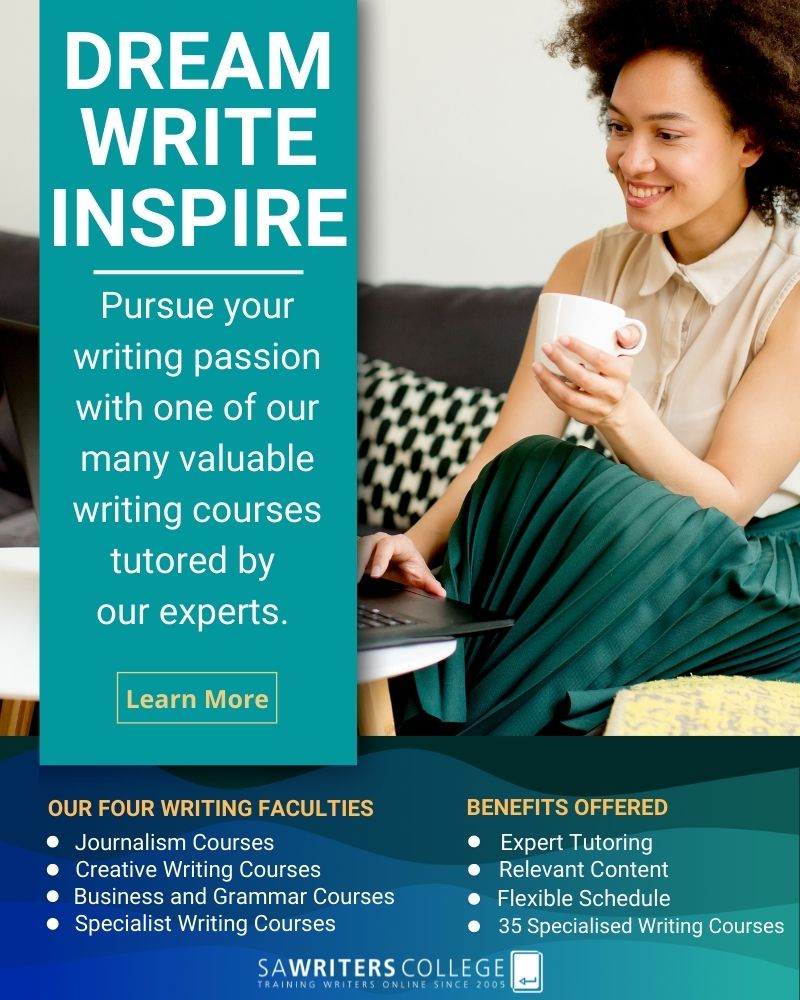
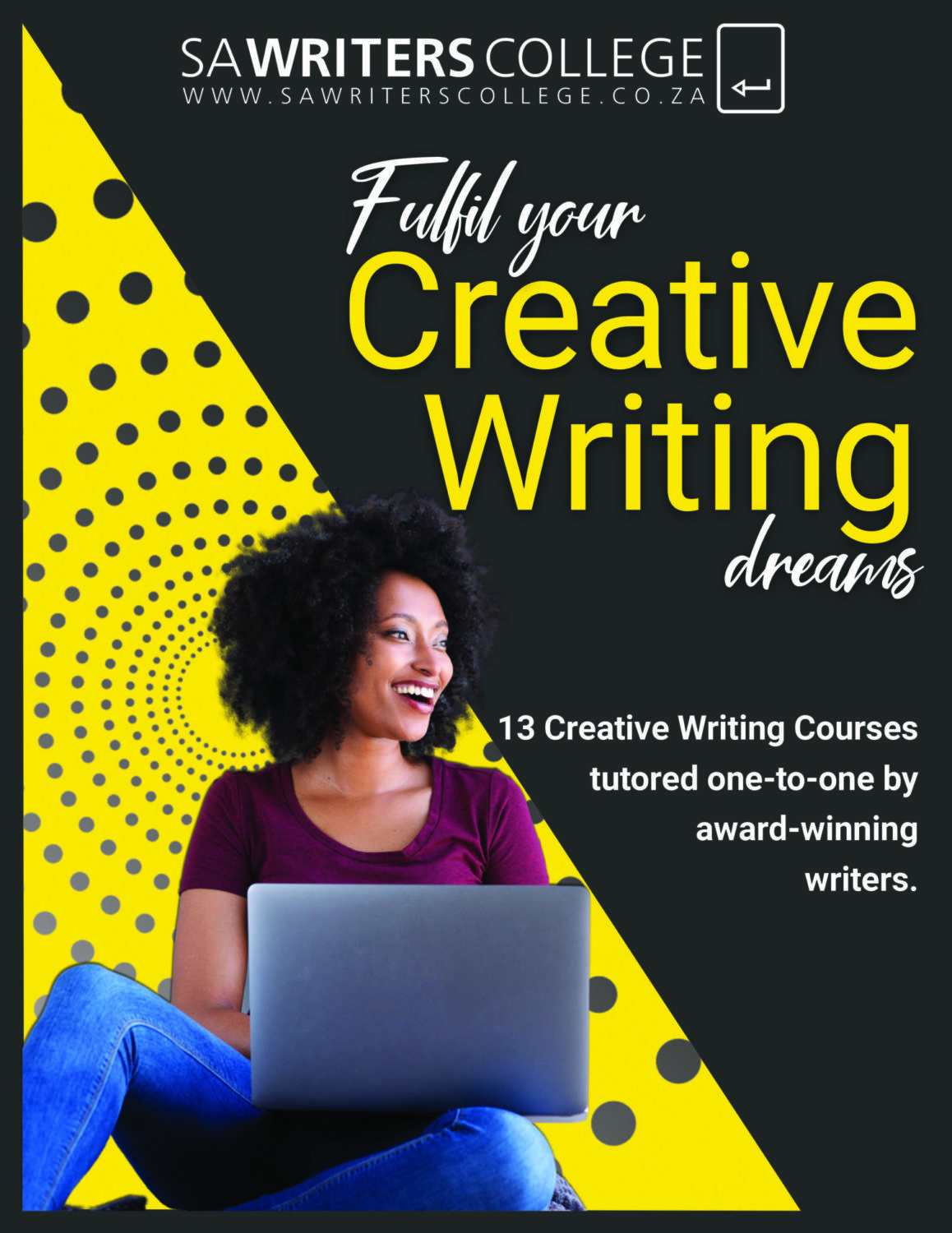
SA Writers’ College is based in Cape Town and has been training writers since 2005. It is the country’s longest-established online writing school, and has launched the careers of several award-winning, best-selling South African authors. The college offers more than 35 writing courses in fiction, memoir, journalism and more, tutored one-to-one by award-winning South African authors including Helen Brain, Alex Smith and Nerine Dorman, with fees typically ranging from around R6,995 to R10,995. Some of their courses are offered in Afrikaans by multi-award-winning Afrikaans authors.
Beyond the College, a genuinely vibrant independent scene has grown up around individual working authors. The Life Righting Collective, including author and doctor Dawn Garisch, runs memoir and life-writing courses and retreats, with bursary places available for writers who can’t afford the fee. Poet and academic Finuala Dowling offers various online writing courses, as well as the DAMD (Deadlines, Audience, Mentoring, Diary) five-month mentoring programme (around R10,000). The University of Cape Town’s Summer School and Centre for Extra-Mural Studies programme runs a five-week course with author and writing coach Sally Cranswick (R2,200). And the Jakes Gerwel Foundation, partnering with LitNet, has run mentorship workshops such as the Kommadagga programme for promising young English- and Afrikaans-language writers.
If you’re looking for a creative writing course under R700, you can try the writing intensives offered here.
Join South African writing communities and forums
Writing can feel solitary, and connecting with others provides essential support, broadens your sense of style and sharpens your own work through giving and receiving feedback.
SA Writers’ College curates a list of writing circles in South Africa. Find them here: https://www.sawriterscollege.co.za/writing-circles-in-south-africa/
LitNet, South Africa’s largest multilingual (Afrikaans and English) online literary journal, hosts original new writing, author interviews, reviews and ongoing forums, and is a genuine hub for the local writing community rather than just a news site. Independent workshop hosts such as Jen Thorpe (in-person in Cape Town and online via Zoom, from around R400–R500 a session) and novelists Maire Fisher and Chantal Stewart run regular, affordable, community-minded workshops in Cape Town. International peer-feedback communities such as CritiqueCircle, Wattpad and InkedVoices, and forums such as WritingForums and Scribophile, remain open and useful to South African writers too.
Whichever door you walk through, the principle holds: you don’t need to do this alone.
Join South African professional bodies and writers’ organisations
PEN South Africa, founded in 1927 and one of over 140 PEN International centres worldwide, is open to writers across the Southern African Development Community and advocates for freedom of expression; its current president is Bongani Kona.
For non-fiction and academic writers specifically, ANFASA (the Academic and Non-Fiction Authors’ Association of South Africa) is an often overlooked but genuinely valuable professional body. Its mission applies broadly to all authors; it lobbies for authors’ rights including Public Lending Right, and it runs an annual Grant Scheme for Authors (see below).
DALRO (the Dramatic, Artistic and Literary Rights Organisation), established in 1967, is South Africa’s accredited Reproduction Rights Organisation: it licenses the reproduction of copyright text and distributes the resulting royalties to authors and publishers, functioning much like the UK’s ALCS or New Zealand’s CLNZ.
PASA (the Publishers’ Association of South Africa) is the country’s largest publishing industry body, maintaining a directory of member publishers and representing the sector to government and internationally.
Explore South African funding and grants for writers, fiction and non-fiction
Funding can be the difference between finishing a project and shelving it, and South Africa has real money on the table for both fiction and non-fiction writers.
The National Arts Council of South Africa (NAC), a statutory body, runs Annual Project Funding across seven disciplines including Literature, with grants of up to R350,000 per project for South African citizens, through a competitive, independently-assessed application process.
For non-fiction and academic writers specifically, ANFASA’s Grant Scheme for Authors (AGSA) is a standout, purpose-built resource: it offers roughly R20,000 to R30,000 per grant to help an author ‘buy time’ to write or travel for research and is open to scholarly and general non-fiction projects. Up to fifteen grants are awarded most years, and new and first-time authors are especially encouraged to apply. Membership at ANFASA, active at the same time as your application, is the only real barrier to entry.
Fiction writers should also note Jacana Media’s Dinaane Debut Fiction Award (R35,000 plus a publishing contract) and, more broadly, publisher-run prizes that double as funding routes rather than pure recognition.
Find South African publishers and literary agents
Jacana Media and its science-fiction and fantasy imprint, Mother, is unusually open to direct, unagented submissions across fiction, memoir, history and politics, as is Penguin Random House. Modjaji Books, a Cape Town feminist press, opens periodic submission windows for novels, short story collections and creative non-fiction by South African writers. By contrast, some major houses may not accept unsolicited manuscripts, so always check a publisher’s current submissions page before sending anything.
For agent representation, which is optional in South Africa, The Lennon-Ritchie Agency, with offices in Cape Town and Johannesburg, represents literary and commercial fiction, non-fiction and children’s literature, and has represented work shortlisted for prizes including the Booker Prize and the South African Literary Awards. The Publishers’ Association of South Africa (PASA) member directory remains the broadest single place to identify South African publishers by category.
Submit to South African literary magazines and journals
Getting published in literary magazines builds a portfolio, sharpens your editing instincts and can attract the attention of publishers and agents. South Africa’s literary journal scene has real depth:
- New Contrast, founded in 1960 and patronised by Nobel laureate J. M. Coetzee and Windham–Campbell Literature Prize winner Zoë Wicomb, is South Africa’s longest-running literary journal, publishing poetry, prose, reviews and art in English and Afrikaans. All submissions need to be made through Submittable.
- New Coin Poetry, founded in 1965 and published twice yearly by the Institute for the Study of English in Africa at Rhodes University, focuses specifically on innovative South African poetry.
- The Johannesburg Review of Books, an independent online literary review, publishes reviews, essays, poetry, photography and short fiction from South Africa, broader Africa and beyond, with an open submissions process.
Always check current submission windows and guidelines before sending anything, since these change from year to year.
Grammar, style guides and reference materials for South African writers
Style guides such as the New Oxford Style Manual (UK conventions) and the Chicago Manual of Style (US conventions) remain widely used by South African publishers and academic presses, and APA or MLA guidance still governs most scholarly writing.
South Africa’s own linguistic landscape adds a dimension no imported style guide covers fully: with twelve official languages, writers working across English, Afrikaans and the country’s African languages benefit from dedicated local references. Pharos (an imprint of NB Publishers, founded in 1996) produces the standard Afrikaans–English and English–Afrikaans dictionaries used across South African publishing and education, and also publishes bilingual dictionaries pairing English with isiZulu, isiXhosa, Sepedi, Sesotho, Setswana, siSwati, Tshivenda and Xitsonga. For English usage specifically shaped by South African idiom, SA Writers’ College notes that it actively encourages students to write with an authentic South African voice rather than defaulting to British or American convention, which is worth bearing in mind whatever reference you reach for.
Check your target publisher’s or journal’s own house style before committing to one system, since this varies as much in South Africa as anywhere else.
Choose the right resources for your writing
South Africa has given the world some of its most urgent, unforgettable writing, both fiction and non-fiction, forged in a country where stories have always mattered enormously. You are writing into that tradition, with more structural support available to you than you might have realised: courses led by working authors, a non-fiction association that will help fund your research, a national arts council that takes literature seriously as a discipline in its own right, and publishers still willing to open an email from a writer they’ve never met.
Choose the resources that fit where you are right now, and come back to this list as your project changes. The right mix, applied consistently, is what turns a writer who wants to finish something into one who has a completed manuscript.
Resources
- SA Writers’ College. Online Writing Courses. https://www.sawriterscollege.co.za/
- Thorpe, J. (2025, December 23). Treat yourself to creative writing workshops with me in 2026. https://jen-thorpe.com/2025/12/23/treat-yourself-to-creative-writing-workshops-with-me-in-2026/
- Life Righting Collective. https://liferighting.com/
- Finuala Dowling. Courses and mentoring 2026. https://finualadowling.com/courses-and-mentoring-2026/
- University of Cape Town. Write A Novel That Sparkles! https://learningstore.uct.ac.za/product?catalog=Novel-That-Sparkles
- PEN South Africa. pensouthafrica.co.za.
- ANFASA. https://www.anfasa.org.za/
- DALRO. https://dalro.co.za/about/
- PASA. https://publishsa.co.za/
- National Arts Council. https://www.nac.org.za/
- Jacana Media. https://jacana.co.za/
- Modjaji Books. https://modjajibooks.co.za/
- The Lennon-Ritchie Agency. https://lennonliterary.com/
- New Contrast. https://www.newcontrast.net/
- New Coin Poetry. https://www.ru.ac.za/isea/publications/journals/newcoinpoetry/
- The Johannesburg Review of Books. https://johannesburgreviewofbooks.com/
- LitNet. https://www.litnet.co.za/
- The Jakes Gerwel Foundation. Application: Kommadagga Workshop. https://jgf.org.za/application-kommadagga/